Today, smartphones and cameras are ubiquitous throughout society and often synonymous with innovation. Yet, cameras, and photography in general, have fundamental limitations – neither is a reliable source of information about color, only able to capture the ‘appearance’ of objects and unable to measure or match color. IlluminateAI’s innovation breaks the limits of cameras through measuring the physical world and by accounting for light.
Why Cameras Are Not a Reliable Source of Information
We know that cameras cannot measure color, because color changes with lighting conditions. If you change the lighting, you change the apparent color of an object, as the figure below illustrates. This is why most photographs can’t be used to measure or match color, and creates a fundamental challenge for AI’s ability to interpret images. For example, a photograph can’t be used to identify the color of a dress [Witzel C, Racey C, O’Regan JK. “The most reasonable explanation of ‘the dress’: implicit assumptions about illumination.” Journal of Vision (2017)], or judge if a baby has jaundice [Jiménez-Díaz G et al. “Validation of a Mobile Health Device for Neonatal Jaundice …” (2025)]. Similarly, if a person is under a yellow light their skin looks golden, if they stand under a dim light they look tan, with shadows on their face their skin looks non-uniform. The appearance of objects changes dramatically as the intensity or color of light shining on the object varies, in mixed lighting environments and in the presence of shadows.
Sensitivity to lighting conditions makes photographs an unreliable source of information for human and AI decision making. As illustrated by “the dress”, a photograph cannot be used to shop for color because it does not contain enough information, and the image is consistent with multiple combinations of dress color and lighting conditions. For beauty applications, selfies are not a reliable source of information for choosing products which match skin color. For telehealth and dermatology applications, smartphone photos cannot reliably be used to diagnose or quantify jaundice or other skin conditions because lighting, device variation, and skin-pigmentation effects materially affect the image. Finally the smartphone image pipeline adds further ambiguity to image data due to device-specific spectral sensitivities, white-balance routines and color rendering. This is why consumers can’t easily shop for color using their smartphone, doctors struggle to interpret photographs their patients share, and AI can’t be sure that what it sees in an image is accurate.
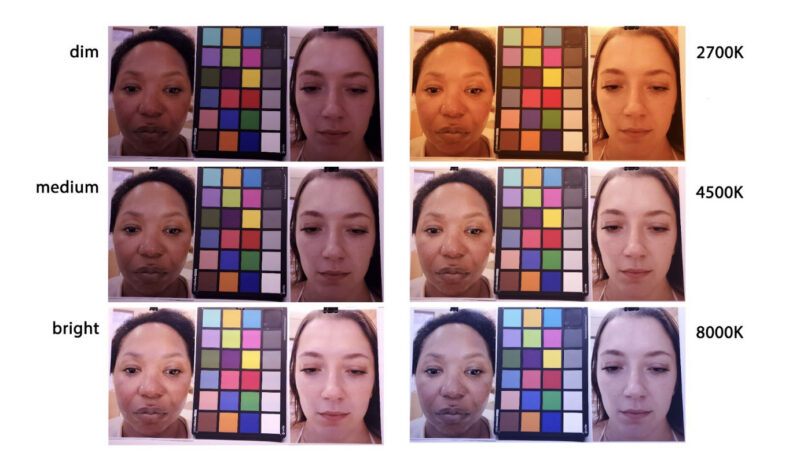
Figure 1. Can you tell which photograph captures her true skin color? The appearance of faces and objects (such as a ColorChecker card) varies, as the intensity (left) and color temperature (right) of the lighting changes. Cameras can only capture ‘apparent color’ which is dictated by lighting conditions and the reflectivity of the object. This is why photographs are not a reliable source of information about color or reflectivity. Shadows and mixed lighting can make this even worse. Unreliable visual data makes it difficult for AI to interpret images and make decisions.
Accurate image capture is at the core of what illuminateAI is doing as AI is dependent on data. If you don’t have good input data, then the capabilities of AI are incredibly limited.